Top Auto Syringe Manufacturers in China for Global Buyers

Choosing an Auto Syringe manufacturer in China takes more than comparing prices or polished product photos. Global buyers need to assess design capability, production consistency, documentation, and communication. A syringe may look simple on a specification sheet. Its materials, assembly tolerances, and user feedback can matter greatly in practice.

Healthcare quality expert Dr. Don Berwick offers a useful principle: “Every system is perfectly designed to get the results it gets.” For buyers, that means asking how a supplier controls each production step—not just what its brochure promises. Request clear information about quality checks, traceability, product testing, and the documentation relevant to your destination market. Where customization is offered, confirm how design changes are reviewed and recorded. Details matter.

This outline will help readers compare Chinese manufacturers through practical questions about product range, engineering support, factory processes, and export experience. It will also consider how buyers can evaluate samples and communicate requirements before placing an order. A shortlist is only a starting point. Supplier claims still need verification, and a responsive sales contact cannot replace evidence. Some details may remain unclear until discussions begin; that is worth acknowledging, not glossing over.
Top Auto Syringe Manufacturers in China for Global Buyers

Understanding Auto-Disable Syringes and Their Global Applications

Understanding Auto-Disable Syringes and Their Global Applications

Auto-disable syringes are designed to deliver one injection and prevent reuse through a built-in locking or disabling mechanism. WHO and UNICEF’s joint 2003 policy recommended their use in immunization services. The scale is substantial: WHO’s 2016 injection-safety guideline estimates that about 16 billion injections are given worldwide each year. Many take place in busy clinics, where a clear single-use design can reduce reliance on staff remembering every handling step.

One use only.

Their applications include routine vaccination, mass immunization campaigns, and outreach clinics serving remote communities. Yet the device alone cannot guarantee safe care. Staff need training, and used syringes need prompt disposal in suitable sharps containers. Procurement teams should check compatibility with the intended dose and procedure, packaging integrity, and clear instructions. A small usability issue, such as a stiff plunger, may slow work in a crowded clinic; that practical detail deserves attention during evaluation.

Tips: Before large orders, ask clinical staff to assess samples using realistic workflows. Check the relevant WHO guidance and local procurement specifications, and confirm that storage and disposal plans are ready. A safety feature helps, but it is not a substitute for training.

China’s Auto-Disable Syringe Manufacturing Landscape

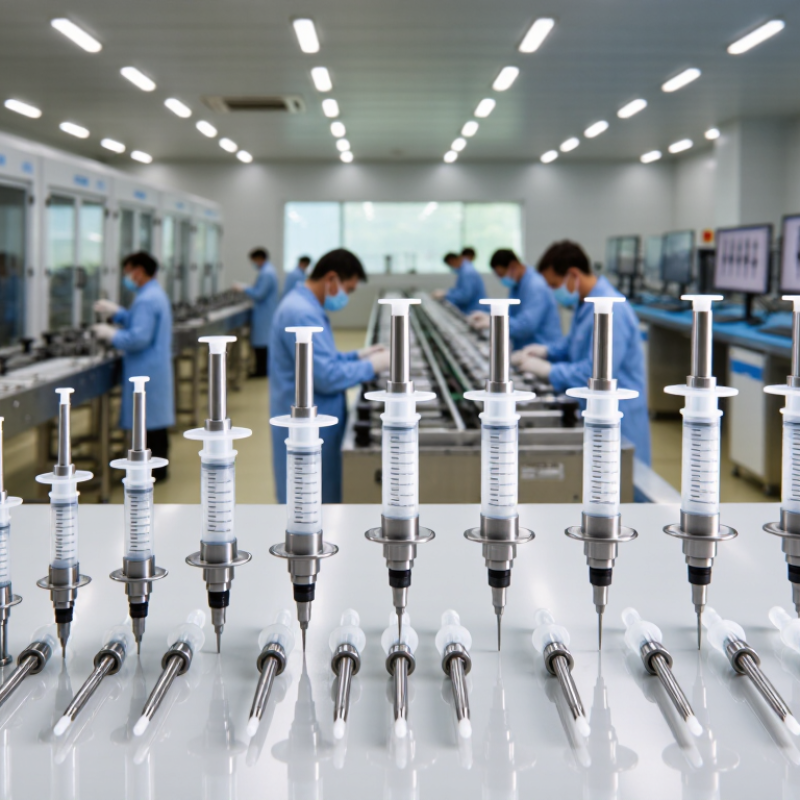
China’s auto-disable syringe manufacturing landscape includes facilities with different levels of specialization, automation, and export experience. Production may involve plastic molding, needle assembly, plunger fitting, and sterile packaging. On the factory floor, buyers can examine mold consistency, clear measurement markings, and packaging seals. Small details matter.

An auto-disable mechanism is designed to prevent reuse after one injection, but performance depends on reliable assembly and testing. Buyers should ask how the locking feature is verified across production batches. Review sample syringes, inspection records, and documentation for materials and sterilization processes. A polished sample is not enough. Testing should reflect routine production, not only a carefully prepared batch.

Supplier evaluation also benefits from direct technical questions. Ask how defects are recorded, how batch traceability works, and what happens when a test fails. Check whether the supplier can support the required specifications and packaging configuration for the intended market. Responses may be incomplete at first; that deserves follow-up, not an assumption of poor quality. Price alone tells little about process control, delivery reliability, or the evidence behind a product’s stated performance.

Leading Chinese Auto-Disable Syringe Manufacturers

Leading Chinese auto-disable syringe manufacturers serve global buyers with products designed to prevent reuse after one injection. Their engineering focuses on a reliable locking or plunger-break mechanism, smooth dose delivery, and clear user feedback. Small details matter. A plunger that stops too early can frustrate a clinician; one that fails to lock undermines the device’s purpose. Buyers should ask how designs are validated across intended volumes and use conditions.

Strong suppliers can explain material selection, molding controls, assembly checks, and sterilization validation in plain language. Request traceable batch records and representative test data, not only attractive catalog images. A factory visit can reveal practical discipline: calibrated gauges, organized production areas, and operators who can describe defect handling. These observations do not replace independent assessment, but they add useful context. Documentation matters.

For procurement teams, compare needle options, barrel readability, packaging integrity, production capacity, and change-control practices. Confirm that samples match the specifications for repeat orders. Communication deserves equal attention; delayed answers about a failed test may signal weak process ownership. No supplier is flawless. Even a careful review can miss a gap, so maintain incoming inspections and review performance after launch. The best partnership is measurable, responsive, and transparent.

How to Evaluate Manufacturers for Quality and Compliance

When comparing Chinese auto-syringe manufacturers, check whether certificates match the exact product and production site. ISO 13485 certification matters, but its scope and expiry date matter too. For auto-disable syringes, ask for test evidence against ISO 7886-3. Request batch records, sterilization validation, biocompatibility results, and documented checks for dose accuracy, leakage, and device function. Ask to see how rejected units are identified and separated on the factory floor.

Paperwork can look reassuring. It is not proof. WHO’s 2017 Global Surveillance and Monitoring System report estimates that one in ten medical products in low- and middle-income countries is substandard or falsified. This estimate covers medical products broadly, not syringes alone, but it underlines why supplier controls deserve close review. Request recent independent test reports, then confirm the laboratory, sample identity, and test date. A report for a similar model is not enough.

During a site audit, observe assembly, in-process inspection, and packaging rather than relying only on a presentation. Ask how the manufacturer traces a finished lot back to materials and sterilization records. For export markets, verify that product registrations and technical files match the destination’s requirements. A witnessed production check can reveal more than a polished audit file. Still, audits capture one moment; repeat reviews help uncover drift.

Top Auto Syringe Manufacturers in China for Global Buyers - How to Evaluate Manufacturers for Quality and Compliance

Evaluation Dimension What to Check Evidence to Request Why It Matters
Product and intended use Confirm whether the product is a conventional single-use syringe, an auto-disable syringe, or a syringe with another reuse-prevention feature. Match the design to the intended clinical use, capacity, needle configuration, and target market. Product specifications, drawings, instructions for use, intended-use statement, and a clear list of available configurations. Different syringe types and uses may require different design controls, testing, and regulatory documentation.
Applicable product standards Check whether the product and its claimed features are assessed against relevant standards. ISO 7886-1 covers sterile hypodermic syringes for single use; ISO 7886-3 addresses auto-disable syringes for fixed-dose immunization; ISO 7886-4 covers syringes with reuse-prevention features. Test reports identifying the exact model, configuration, standard number and edition, test laboratory, and results. Confirm that any claimed standard applies to the product being purchased. A certificate or test report for a different model, configuration, or standard edition may not support the product offered.
Quality management system Assess whether the manufacturer operates a medical-device quality management system and whether its scope covers the relevant manufacturing activities and product type. Current ISO 13485 certificate, issuing body and accreditation details, certificate scope, validity dates, and relevant audit or corrective-action records where available. A quality-system certificate is useful evidence, but it does not by itself prove that an individual syringe model meets every product requirement.
Regulatory market access Verify requirements for each destination market. For China, check applicable NMPA registration or filing status. For the EU, assess applicable MDR requirements. For the United States, confirm applicable FDA establishment and device obligations, including the QMSR effective February 2, 2026. Market-specific registration or authorization records, device classification rationale, current labeling, and documentation showing the legal manufacturer and authorized representatives where required. Regulatory status is market-specific; approval or registration in one jurisdiction does not automatically authorize sale in another.
Sterilization and sterility assurance Identify the sterilization method, validated process, release criteria, and controls for maintaining sterility through the stated shelf life. Sterilization validation and routine monitoring records, sterility assurance documentation, packaging validation, and lot-specific release records. Reliable sterilization and intact sterile-barrier packaging are essential for products labeled sterile.
Biocompatibility and materials Review the materials that contact the patient or medication, including the barrel, plunger, gasket, lubricant, and needle where supplied. Check the biological evaluation appropriate to the nature and duration of contact. Material specifications, supplier controls, biological evaluation documentation, and test reports relevant to the finished device and intended use. Material composition and manufacturing residues can affect safety, compatibility, and product performance.
Auto-disable function and performance For auto-disable models, verify that the mechanism activates as intended and prevents reuse without obstructing the specified injection. Review leakage, dose accuracy, dead space, and functional performance against applicable requirements. Design verification and validation reports, representative sample test results, acceptance criteria, and documented controls for mechanism defects. The defining safety function must work consistently across production, not only on selected samples.
Production controls and traceability Review controls for incoming materials, molding, assembly, inspection, nonconforming product, and changes to processes or suppliers. Confirm that finished goods can be traced to production lots. Process-control overview, inspection plans, lot coding examples, batch records, change-control procedure, and complaint or recall procedures. Traceability and controlled processes help identify, contain, and investigate quality issues.
Packaging, labeling, and shelf life Check sterile-barrier integrity, transport protection, storage conditions, shelf-life support, and consistency of labels and instructions with the destination market. Packaging validation, distribution or transport testing where applicable, shelf-life evidence, sample labels, and instructions for use in required languages. Packaging damage, unsupported expiry dates, or noncompliant labeling can make otherwise acceptable products unsuitable for import or use.
Supplier verification and purchasing Evaluate the manufacturing site, not just a trading intermediary. Confirm who holds the product registration, who manufactures the device, and who is responsible for release and post-market support. Site details, manufacturing and quality agreements where applicable, audit access arrangements, authorized supplier information, and written confirmation of roles and responsibilities. Clear accountability reduces risks involving undisclosed subcontracting, inconsistent products, and gaps in regulatory documentation.

Use this table as a buyer’s due-diligence checklist, not as a ranking or certification. Verify current standard editions and destination-market requirements with the relevant regulator or qualified regulatory specialist before purchase.

Export, Sourcing, and Supplier Selection Considerations

For global buyers, supplier selection should begin with the intended use, not a catalogue photo. Confirm the auto-disable mechanism, needle size, barrel capacity, packaging, and sterilization method in writing. WHO estimated that about 16 billion injections were given worldwide each year, underscoring the need for dependable injection safety. The figure appears in its 2016 injection-safety fact sheet. Ask suppliers for current quality-system documentation, batch traceability, and test records that match the exact product offered.

Export checks deserve equal attention. Request samples from routine production, then inspect the plunger movement, printed graduations, needle shield, and sealed packaging. Compare sample results with the technical file and production specifications. Clarify lead times, minimum order quantities, carton dimensions, and how complaints or rejected lots are handled. A tidy brochure is not proof. An audit can still miss a small but important difference between sample and shipment; build independent inspection into the purchase plan. Trade statistics can help assess market activity, but broad syringe categories may not identify auto-disable models separately.

Tips: Ask for evidence. Confirm destination-market registration and import documentation with qualified local advisers. Keep approved samples, test reports, and written specifications together before placing repeat orders.

Request a Quote

For more information on our instruments, consumables, or services, or to request a quote, complete the contact form below, and one of our associates will reach out to you!

Request a Service Quote

To request service on your machine(s), complete the contact form below, and one of our associates will reach out to you!

Browse by:

  • Test Property
  • Manufacturer