How to Perform Thermal Conductivity Testing Effectively?
Thermal conductivity testing is a crucial process in materials science, impacting various industries such as construction and electronics. Dr. Emily Carter, a renowned expert in the field, emphasizes, "The accuracy of thermal conductivity testing can determine the efficiency of thermal insulation in buildings." This statement highlights the importance of precise testing methods.
In thermal conductivity testing, even minor errors can lead to significant discrepancies. Using a suitable testing method is vital for reliable results. For instance, the transient hot-wire method is commonly used for solid materials, while the guarded hot plate technique suits layered structures. Each method presents unique challenges and offers insights.
Conducting thermal conductivity testing effectively requires careful attention to detail. Ensuring that samples are prepared uniformly is essential. Inconsistent samples can skew results and misinform applications. Testing environment conditions must be controlled to avoid external influences. Reflection on these procedures can improve testing quality and outcomes.

Understanding Thermal Conductivity and Its Importance in Testing
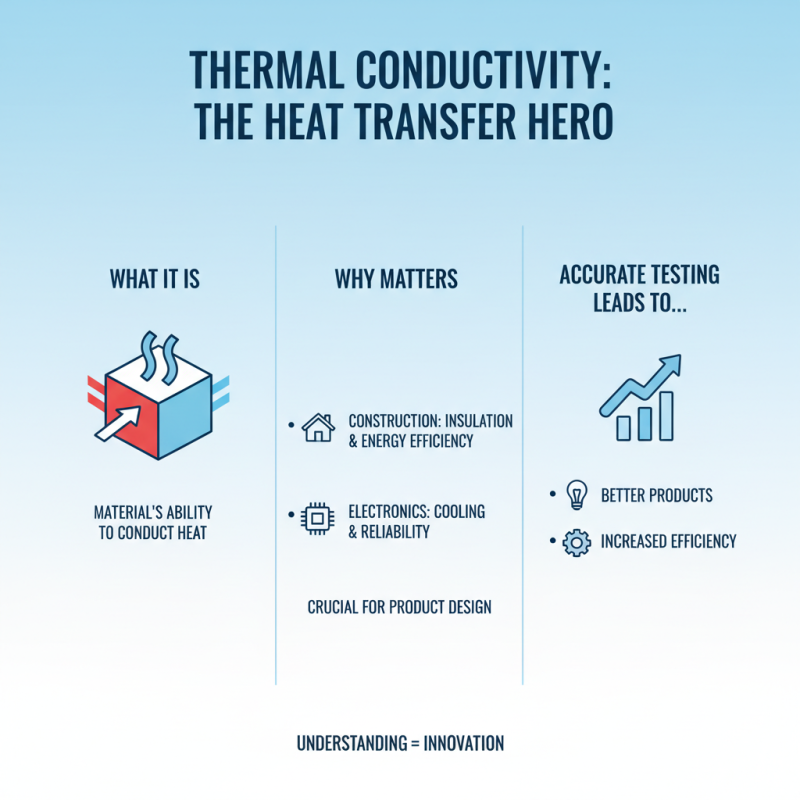
Thermal conductivity is a key property in materials science. It measures a material’s ability to conduct heat. Understanding thermal conductivity is crucial in many industries, from construction to electronics. Accurate testing can lead to better product design and increased efficiency.
The importance of thermal conductivity testing cannot be overstated. Proper testing ensures materials can withstand temperature changes. This is vital in environments that experience extreme temperatures. For instance, in building insulation, a good thermal performance lowers energy costs. However, not every method of testing is reliable. Some approaches may not reflect real-world conditions. Experimenters should be cautious about choosing their testing methods.
Thermal conductivity can vary due to several factors, including material composition and structure. This variability makes it essential to use standardized testing procedures. Sometimes, results can be misleading if procedures are not followed. Re-evaluating methods may help in achieving more accurate outcomes. Continuous improvement is often needed in this area, and researchers should remain open to changing their techniques for better results.
Overview of Common Methods for Measuring Thermal Conductivity
Thermal conductivity testing plays a crucial role in material science. It measures how well a material can conduct heat. Several methods exist, each suited for specific materials and conditions.
One common method is the guarded hot plate technique. This method provides reliable measurements for solid materials. It involves placing a sample between two plates, one heated and one cooled. The temperature difference determines the thermal conductivity. This method, however, can be time-consuming and requires precise control.
Another method is the laser flash analysis. This technique is faster and can be used for solids and powders. It involves a short laser pulse on one side of the sample, measuring the temperature rise on the other side. This method might produce less accurate results for highly heterogeneous materials.
Tips for effective thermal conductivity testing include maintaining a controlled environment. Fluctuations in temperature and humidity can affect the results. Also, ensure proper sample preparation; irregular surfaces can lead to error. Checking the calibration of equipment is essential to maintain accuracy. By following these guidelines, you can enhance the reliability of your measurements.
How to Perform Thermal Conductivity Testing Effectively? - Overview of Common Methods for Measuring Thermal Conductivity
| Method |
Principle |
Sample Type |
Temperature Range (°C) |
Accuracy |
| Guarded Hot Plate |
Steady-state heat transfer |
Solids |
0 to 70 |
±5% |
| Laser Flash Analysis |
Transient heat transfer |
Solids & Powders |
-200 to 1000 |
±2% |
| Transient Plane Source Method |
Transient heat flow |
Solids, liquids, and gases |
-100 to 500 |
±3% |
| Heat Flow Meter |
Steady-state with a heat flowmeter |
Insulating materials |
-20 to 70 |
±10% |
Essential Equipment and Materials for Effective Thermal Conductivity Testing
Effective thermal conductivity testing requires specific equipment and materials to ensure accurate results. A heat flow meter is essential. It measures the rate of heat transfer through materials. This device provides precise data to evaluate thermal performance. According to the American Society for Testing and Materials (ASTM), using calibrated equipment can yield results with an accuracy of +/- 2%.
Another critical component is the sample preparation area. Sample thickness, surface finish, and uniformity impact measurements. Material inconsistencies can lead to skewed results. For example, samples that are poorly matched can introduce errors in testing. It’s also vital to ensure a controlled environment. Experiments conducted under fluctuating temperatures can yield unreliable data.
Insulation is equally important during testing. Utilizing insulation around samples minimizes heat loss. This step ensures that the measured conductivity reflects the sample’s true properties. A detailed thermal analysis can often indicate weaknesses or variations in material properties. A well-structured testing process can uncover areas for improvement in both testing methodology and material selection.
Thermal Conductivity Testing: Comparison of Common Materials
Step-by-Step Protocol for Conducting Thermal Conductivity Tests
Conducting thermal conductivity tests requires precise methods to ensure accurate results. Start by selecting an appropriate testing apparatus such as a laser flash analyzer or steady-state method setup. The thermal conductivity of materials varies significantly; for example, metals like copper exhibit high conductivity around 400 W/mK. In contrast, insulators like polystyrene measure around 0.04 W/mK. Understanding these differences is essential for application in fields like building materials or electronics.
Prepare samples according to standardized dimensions. This ensures that the test results are reproducible and reliable. Temperature control is crucial. Variations can lead to discrepancies. Aim for a testing environment where temperature can be regulated to within 1°C. Measurements should be taken under consistent pressure conditions. It’s also important to replicate tests multiple times to account for any anomalies, which could skew data interpretation.
Documentation is often overlooked. Keep detailed records of each trial, including temperature readings, sample dimensions, and testing conditions. Reported values should specify units and any variations observed. Anomalies may signal equipment malfunction or sample defects. Reflecting on these factors will improve the reliability of future tests and enhance understanding of thermal properties.
Analyzing and Interpreting Results from Thermal Conductivity Tests
Thermal conductivity testing is crucial for material evaluation. Understanding the results requires careful analysis and interpretation. Begin by examining the measured values against expected standards. High or low conductivity may indicate potential issues with thermal insulation or energy efficiency.
Consider variations in sample preparation. Inconsistent dimensions or surface irregularities can yield misleading results. It's important to maintain standard conditions, like temperature and humidity, during testing. Small errors can greatly affect outcomes.
Tips for analysis: Always compare your findings with historical data. This offers context and a frame of reference. Use graphical representations of data for better clarity. Visual aids can highlight trends. Don’t hesitate to consult peers or experts for insights. Collaborative discussion often uncovers overlooked details. Be prepared to revisit your methods if results seem off. Continuous improvement leads to more precise evaluations.